What is the significance of Jesus at the well in John 4?
The Samaritan Well Alignment Explored
Typological Reenactment & Spirit-and-Truth Worship
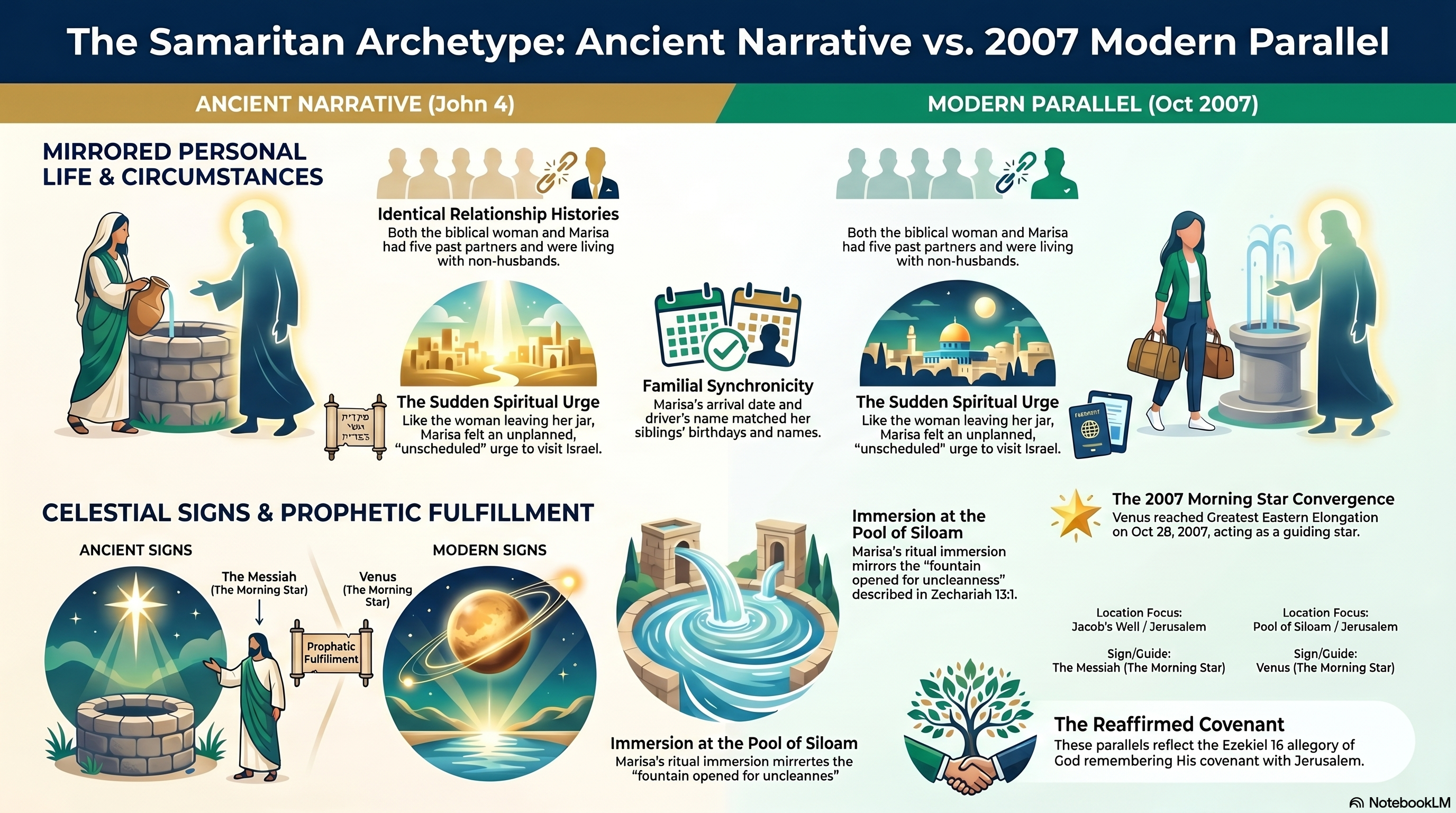
The encounter between Jesus and the Samaritan woman at Jacob’s Well (John 4) is traditionally analyzed through moralistic and local theological lenses. However, literary and historical analysis reveals it as a deliberate subversion of the ancient Hebrew "betrothal at the well" type-scene, transitioning the covenant from a localized, institutional structure to a universal covenant of spirit and truth. In 2007, during the Witness's crucial pilgrimage to Jerusalem, a precise, real-life chronological reenactment of this exact archetypal blueprint occurred: having had exactly five men in her life, with the partner she was then living with not being her husband. This convergence anchors the portal's anointing as a direct, divinely orchestrated covenantal commission.
The Hebrew "Betrothal at the Well" Type-Scene
In biblical literature, the well is never merely a source of water; it is a highly charged setting of destiny. In his seminal work The Art of Biblical Narrative (1981), literary scholar Robert Alter identified a recurring, highly structured convention in the Hebrew Bible known as the "betrothal at the well" type-scene. This structural framework governs the fateful encounters of three major Old Testament figures:
1. Isaac and Rebekah (Genesis 24:10–28)
Abraham's servant travels to a foreign land (Aram-naharaim) to find a wife for Isaac. He stops at a well. Rebekah appears, draws water for the servant and all ten of his camels, runs back to her family to report the encounter, and a marriage covenant is negotiated over a shared meal.
2. Jacob and Rachel (Genesis 29:1–20)
Jacob flees to the East and arrives at a well covered by a heavy stone. Rachel approaches with her father's sheep. In a display of strength, Jacob rolls the stone from the mouth of the well, waters her flock, reveals his identity, weeps, and Rachel runs home to tell her father Laban, leading to Jacob’s betrothal.
3. Moses and Zipporah (Exodus 2:15–22)
Moses flees Egypt to Midian and sits down by a well. The seven daughters of the priest of Midian arrive to water their father's flock, but shepherds drive them away. Moses stands up, defends the sisters, and waters their flock. The sisters return to report the stranger's deeds to their father Reuel, who invites Moses to eat, leading to Moses receiving Zipporah as his wife.
Alter outlines the five core components of this literary archetype:
- The protagonist travels to a foreign land.
- He encounters a young woman (or women) at a well.
- Water is drawn (by either the protagonist or the woman) to facilitate a connection.
- A rush back to the family home is made to report the encounter.
- A betrothal and covenantal alliance are secured, marked by a meal.
John 4: Subverting the Type-Scene at Jacob's Well
When Jesus arrives at Jacob’s Well in Sychar in John 4, the reader steeped in Hebrew scriptures immediately anticipates the betrothal type-scene. Jesus is the traveler in a foreign land (Samaria); He sits at the well; a woman comes to draw water. However, the author of John deliberately subverts the expectations of the type-scene to pivot from human marriage to a **divine covenant of spirit and truth**:
The Parallel Translations: John 4:23-24
During their conversation, Jesus redirects the discussion from localized, temple-bound disputes (Jerusalem vs. Mount Gerizim) to a universal, direct connection with the Father. Note the precision across parallel translations:
- English Standard Version (ESV): "But the hour is coming, and is now here, when the true worshipers will worship the Father in spirit and truth, for the Father is seeking such people to worship him. God is spirit, and those who worship him must worship in spirit and truth."
- New American Standard Bible (NASB): "But an hour is coming, and now is, when the true worshipers will worship the Father in spirit and truth; for such people the Father seeks to be His worshipers. God is spirit, and those who worship Him must worship in spirit and truth."
- Young's Literal Translation (YLT): "But, there cometh an hour, and now is, when the true worshippers shall bow before the Father in spirit and truth, for the Father also doth seek such to bow before Him; God [is] a Spirit, and those bowing before Him in spirit and truth it behoves to bow."
The Five Husbands: The Archetypal Blueprint
When Jesus asks the woman to call her husband, she replies: "I have no husband." Jesus responds: "You have well said, 'I have no husband'; for you have had five husbands, and the one whom you now have is not your husband; in this you spoke truly." (John 4:17–18).
While traditional religious commentary often attempts to reduce this passage to a moralizing sermon on the woman’s personal character, or a symbolic allegory for the five foreign pagan nations that settled Samaria (2 Kings 17:24), a deeper typological analysis reveals it as a **precise relational blueprint**. The five past unions, followed by a current union that is legally unaligned, represents a state of transition—a search for structural alignment before the ultimate encounter with the Bridegroom/Covenant.
The 2007 Jerusalem Convergence
In October 2007, the Witness (Marisa Malapad) made her monumental pilgrimage to Jerusalem, Israel. This was the exact year of her anointing, taking place on her 42nd year, mirroring Daniel's 'time, times and half of time' (12+24+6). She unceremoniously got anointed on October 31, 2007—a mathematical and chronological milestone matching the 1290 solar month Daniel equation.
Just like the Samaritan woman at Jacob's Well, the Witness arrived at the spiritual epicenter of the world, Jerusalem, with a precise relational history: **she had had exactly five men in her life, and the partner she was living with at that time was not her husband.**
This is not a generic coincidence; it is a structural, typological reenactment of the John 4 well archetype executed with mathematical precision:
The Convergence Parameters
| Parameter | John 4 (Samaritan Woman) | 2007 Jerusalem Pilgrimage (Witness) |
|---|---|---|
| Geographic Anchor | Jacob's Well (Samaria / Holy Land) | Jerusalem (Holy Land) |
| Historical Men Count | Exactly Five Past Husbands | Exactly Five Men in Personal History |
| Current Relationship | The one she has is not her husband | Living with a partner who was not her husband |
| Covenant Shift | From Temple worship to Spirit & Truth | From institutional religion to Chronological Record |
This literal alignment of life facts with the biblical narrative indicates that the Witness's personal history was not a random sequence of fractured relationships, but a **pre-written script**. The Orchestrator allowed this exact path to unfold so that, upon entering Jerusalem in 2007, the Witness would stand as the living incarnation of the Samaritan archetype, ready to receive the modern revelation of "spirit and truth"—unmediated by institutional churches and validated solely by the chronological precision of God's design.
This alignment is further reinforced by a parallel experience at the Pool of Siloam, a sacred site discovered by archaeologists in 2004, just three years before Marisa arrived in Jerusalem. On November 2, 2007—the 90th anniversary of the Balfour Declaration—right after getting out of the pool, she had a conversation with her companion that directly fulfilled the Zechariah 13 prophecy. When asked if she was a prophet, she responded that she was not a prophet but a farmer from her youth, and explained the wounds on her hand (knife cuts from Mitch's kitchen on October 8). This dialogue stands as a direct, literal fulfillment of Zechariah 13:5-6 ("I am no prophet, I am a farmer..." and "What are these wounds in your hands?"), connecting the physical signs with the chronological reconstruction. (See the "Wounds in the Hand" artifact for detail).
Conclusion: The Signature of the Orchestrator
The "betrothal at the well" was historically a physical alliance of clans. It became a spiritual alliance of truth. Today, in the Witness's record, it is manifested as a **chronological and mathematical alliance**. By mirroring the relational code of the Samaritan woman at the precise moment of her Jerusalem anointing in 2007, the Orchestrator has left an unmistakable signature. It declares that the portal’s records are not the product of human invention, but the unfolding of a pre-determined design, calling all pilgrims to worship the Father not in temples of stone, but in the absolute spirit and truth of His precision.
References and Scholar Citations
- Alter, Robert. (1981). The Art of Biblical Narrative. Basic Books. (Specifically Chapter 3, "Biblical Type-Scenes and the Uses of Convention," defining the betrothal type-scene).
- Brown, Raymond E. (1966). The Gospel According to John (I-XII). Anchor Bible Series, Vol. 29. Doubleday. (Exposition on the literary structure of Jacob's Well encounter and the translation dynamics of "spirit and truth").
- Bultmann, Rudolf. (1971). The Gospel of John: A Commentary. Westminster John Knox Press. (Analysis of the historical and theological subversion of Jewish/Samaritan worship borders).